Quick Answer: If your AC is running but not cooling, the most common causes are a dirty air filter restricting airflow, a thermostat set incorrectly or miscommunicating with the system, a frozen evaporator coil, low refrigerant from a leak, or a failing compressor. Start with the filter and thermostat since those are the easiest to check yourself; if the air coming from your vents is warm or barely cool after that, it’s time to call a licensed HVAC technician.
There’s nothing like a 35°C Okanagan afternoon to reveal that your air conditioner isn’t doing its job. Maybe it’s running constantly and the house still feels warm, or maybe air is coming out of the vents but it’s not actually cold. Either way, “why is my AC not cooling” is one of the most common calls we get in Kelowna during peak summer, and the cause is usually one of a handful of things. This guide walks through what to check yourself first, and what symptoms mean it’s a job for a technician.
Start With the Air Filter
A clogged air filter is the single most common reason an AC runs constantly without actually cooling the house. When airflow across the indoor coil is restricted, the coil can’t absorb heat properly, and in more severe cases it can ice over completely, which shuts down cooling almost entirely.
Check your filter by pulling it out and holding it up to a light. If you can’t see light coming through it, it’s overdue for a change. In the Okanagan, where summer dust and wildfire smoke both affect indoor air quality, a filter that would last three months in a cleaner climate can clog in half that time. If you’re not sure how often yours needs changing, our furnace filter guide covers the same filter your AC uses during summer.
Check the Thermostat Settings
It sounds basic, but thermostat issues cause more “AC not cooling” calls than most homeowners expect. A few things to check:
- Confirm the thermostat is set to “Cool,” not “Auto” or “Heat,” since some smart thermostats default back to a previous mode after a power blip or software update.
- Make sure the set temperature is actually below the current room temperature; a thermostat calling for 24°C when the room is already at 23°C won’t trigger the compressor to run.
- If you have a smart thermostat, check that it’s connected to Wi-Fi and receiving schedule updates correctly, since a thermostat stuck on an old schedule can hold the house at the wrong temperature without any obvious error message.
If the thermostat settings all check out and the system still isn’t cooling, the problem is mechanical, not a setting you can fix from the wall panel.
Look for Ice on the Indoor Coil or Warm Air From the Vents
Two symptoms point to two different problems, and telling them apart helps a technician diagnose the issue faster over the phone:
- Warm or room-temperature air from every vent, with the system running: this usually points to a refrigerant issue, a failing compressor, or — in homes with a heat pump rather than a conventional AC — a reversing valve stuck in heating mode. This is not something to troubleshoot further yourself; it needs a licensed technician with gauges to diagnose safely.
- Weak or barely-cool air, sometimes with a faint hissing or bubbling sound near the indoor unit: this often points to a frozen evaporator coil, usually caused by restricted airflow (a dirty filter is the most common cause) or low refrigerant. Turn the system off entirely and let the coil thaw for a few hours before running it again, since running a frozen coil can damage the compressor.
Why Refrigerant Leaks Matter More Than They Used To
If a technician diagnoses low refrigerant, what happens next depends heavily on what refrigerant your system uses. Since January 1, 2025, Canada’s HFC phase-down schedule has restricted the import and production of R-410A, the refrigerant used in the large majority of residential AC systems installed over the last 15 years. New systems installed today use lower-impact refrigerants such as R-454B or R-32 instead.
This matters for an older system with a leak: R-410A is still legal to service, but supply is tightening and costs are rising as the phase-down continues under federal regulations. For a system already close to end of life, this is often the point where repair versus replace becomes a real conversation rather than an easy repair.
For a deeper look at how refrigerant leaks develop and what the repair process involves, see our guide to AC refrigerant leaks in Kelowna.
Outdoor Unit Problems Homeowners Can Actually Check
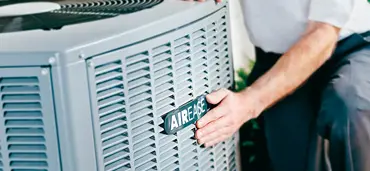
Your outdoor condenser unit needs clear airflow to release the heat it’s pulling out of your home. Before assuming the worst, walk outside and check:
- Clear away leaves, grass clippings, or dust buildup from the fins around the unit, keeping at least 60 cm of clearance on all sides for proper airflow.
- Confirm the outdoor fan is actually spinning when the system is running; a fan that’s stopped while the compressor still runs is a sign of a failed capacitor or motor and needs a technician, not a DIY fix.
- Listen for unusual noises, since a loud humming with no fan movement usually means an electrical component has failed rather than a simple blockage.
When It’s Time to Call a Professional
Filter changes and clearing debris around the outdoor unit are safe for any homeowner to do. Everything involving refrigerant, electrical components, or the compressor itself requires a licensed technician, both for safety and because refrigerant handling requires certification under federal regulations in Canada. If you’ve checked the filter, confirmed the thermostat settings, and the system is still not cooling properly, that’s the point to contact a technician rather than keep testing things yourself in the heat.
Get It Fixed Before the Next Heat Wave
A system that isn’t cooling properly rarely fixes itself, and running it hard in the meantime usually makes the eventual repair more expensive. If you’ve worked through this checklist and your AC still isn’t keeping up, Vision Plumbing Heating Cooling provides AC repair across Kelowna, West Kelowna, Vernon, Summerland, Peachland, and Penticton. Contact Vision for AC repair and get ahead of the next heat wave instead of sweating through it.
Frequently asked questions
Most likely the system is running but can’t move enough heat out relative to how much is coming in. A dirty filter is the most common and cheapest cause to rule out first. If the filter is clean, low refrigerant or a failing compressor are the next most likely culprits and need a technician to confirm.
This is the same issue as above — a system that runs constantly without reaching the set temperature is typically dealing with restricted airflow, low refrigerant, a refrigerant leak, or a failing compressor. Start with the filter, and if that’s not it, call a technician.
No. If the compressor is running but the outdoor fan isn’t turning, the system can overheat quickly. Turn it off at the thermostat or breaker and call a technician rather than letting it run.
Yes. A severely clogged filter restricts airflow enough that the evaporator coil can ice over, which effectively stops cooling until the ice melts and the filter is replaced.
It depends entirely on the cause. A filter change costs almost nothing, while a refrigerant leak repair or compressor replacement is a more significant investment, especially on an older R-410A system given current supply constraints. A technician can give you an accurate number once the actual cause is diagnosed.