Quick Answer: An air filter physically traps particles as air passes through it. An air purifier actively removes contaminants that filters can’t catch, including fine smoke particles, gases, and odours. Most Kelowna homes benefit from both: a MERV 13 filter confirmed compatible with your HVAC system, and a whole-home purifier with carbon and UV components for wildfire smoke season.
The two get used interchangeably in conversation, but air purifiers and air filters do different jobs. In the Okanagan, where wildfire smoke now affects indoor air quality (IAQ) every summer, getting the combination right actually matters. Before diving into what each does, it helps to understand what “air filter” actually means, because there are three different things the term might refer to in your home.
Three Types of Air Filtration, and Where Purifiers Fit
Not all air filtration is the same, and the type you have (or need) depends on your home and what you’re trying to solve.
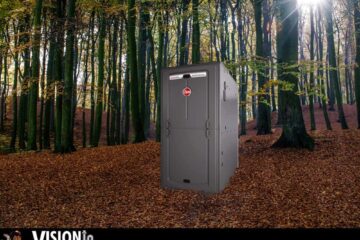
- Your HVAC system filter. Every furnace and central AC unit has a filter in the return air duct. Its primary job is to protect the blower and coil from dust buildup (improving air quality is a secondary benefit). It’s the flat or pleated rectangle you replace every 1–3 months. How well it filters the air depends on its MERV rating, which we cover in detail below.
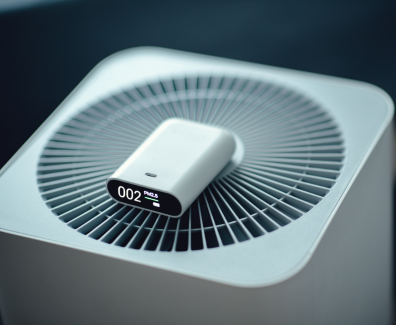
- Standalone portable filter/purifier units. These are self-contained devices — a box with a fan, a filter, and sometimes additional purification stages — that you plug in and place in a room. They treat the air in one space only. Common examples use HEPA filter media, activated carbon, or a combination. They’re useful for bedrooms, home offices, or anyone with specific sensitivities in a particular room.
- Whole-home filtration and purification systems. These install in your existing ductwork and treat all the air moving through your HVAC system. They’re a separate device from your furnace filter — both can coexist in the same duct run, each doing a different job. Whole-home systems range from high-efficiency media filters to electronic air cleaners (EACs) that use charged plates to capture particles as small as 0.1 microns, to UV-C purifiers and activated carbon systems. Vision’s indoor air quality services cover the full range of these systems.
Where purifiers fit. An air purifier — whether standalone or whole-home — is an active system that goes beyond mechanical filtration. It targets what filters miss: gases, odours, VOCs, microorganisms, and ultrafine particles. The right setup for most Okanagan homes combines all three layers: a properly rated HVAC filter, a whole-home purification system in the ductwork, and portable units where extra spot coverage is needed.
Filtering vs. Purifying: The Mechanisms
With that foundation in place, here’s how each purification mechanism works:
- HEPA filtration, which captures 99.97% of particles down to 0.3 microns.
- Activated carbon, which traps gases, smoke odours, and volatile organic compounds (VOCs) that pass straight through standard filters.
- UV-C light, which neutralizes mould spores, bacteria, and some viruses as air passes the lamp.
- Electronic precipitation (electric air cleaners), which uses charged plates to pull fine particles — including those as small as 0.1 microns — out of the airstream. Collector plates are washable, making these low ongoing-cost systems.
The short version: filters block what’s big enough to catch. Purifiers go after what filters miss — including the fine smoke particles and gas-phase pollutants that matter most during a BC wildfire season.
What MERV Ratings Actually Mean
MERV stands for Minimum Efficiency Reporting Value. It’s a 1-to-16 scale developed by ASHRAE that applies specifically to the filter media in your HVAC system — not to standalone units or whole-home purifiers, which have their own performance ratings. It measures how effectively a filter captures airborne particles of various sizes.
Here’s what each band actually catches:
- MERV 1–4: Cheap fibreglass filters. Catch large dust and lint. Protect equipment, not air quality.
- MERV 5–8: Standard pleated filters. Capture mould spores, dust mites, pet dander. Adequate for everyday operation.
- MERV 9–10: Mid-range pleated filters. Capture fine dust, PM10, and some larger smoke particles. A step up from standard but still below the threshold recommended for wildfire season protection.
- MERV 11–13: High-efficiency filters. Capture pollen, fine dust, smog particles, and most bacteria. MERV 13 is the threshold most public health bodies recommend for homes serious about indoor air quality.
- MERV 14–16: Hospital-grade filters. Capture wildfire smoke particles, virus carriers, and PM2.5 down to roughly 0.3 microns.
- HEPA-equivalent (MERV 17+): Used in laboratory and surgical environments. Most residential HVAC systems can’t pull air through HEPA media without an upgraded blower.
The compatibility check. Higher MERV means denser media, which restricts airflow. Older furnaces and AC units sometimes struggle with MERV 13+ filters because the blower wasn’t built for that pressure drop. Before upgrading filter MERV, the system needs to be checked — running a too-restrictive filter on an undersized blower causes overheating, short-cycling, and shortened equipment life. This is the most common mistake we see homeowners make on filter upgrades, which is why a professional HVAC system check should come before any filter swap.
Why This Matters in BC: Wildfire Smoke and PM2.5
Over the past decade, BC has seen a sharp rise in major wildfire seasons, and Kelowna routinely sits in or downwind of the smoke during August and September. Wildfire smoke is the reason filters and purifiers have moved from optional upgrades to seasonal essentials for many Okanagan homes — for a deeper look at how smoke infiltrates your home and what to do about it, see our wildfire smoke and indoor air quality guide. Government of British Columbia air quality monitoring shows that during active wildfire events, Kelowna Air Quality Health Index (AQHI) readings regularly hit 7+ (“high risk”) and occasionally exceed 10 (“very high risk”).
Pollutants that drives those AQHI numbers are often 2.5 microns or smaller (PM2.5), which is small enough to slip through any filter rated below MERV 13.
Health Canada’s guidance during wildfire smoke events recommends staying indoors and running HVAC systems with high-efficiency filtration to reduce indoor PM2.5 concentrations. For Kelowna homes, this translates to a few practical moves:
- Upgrade the HVAC filter to MERV 13 (minimum). Confirm system compatibility first.
- Run the HVAC fan continuously during smoke events, not just on heating or cooling cycles, so air keeps cycling through the filter.
- Add a whole-home air purifier if smoke events affect you for more than a couple of weeks per year. Filtration alone won’t catch smoke odour or VOCs.
Where a Whole-Home Purification System Fits
A whole-home purification system installs in your existing ductwork, downstream of the furnace, and treats every cubic foot of air the HVAC system moves. It sits alongside — not in place of — your HVAC system filter, which continues doing its job of protecting the equipment. Think of the HVAC filter as the first pass, and the whole-home purifier as the second pass targeting what the filter misses.
Three reasons we recommend whole-home purification systems in the Okanagan:
- Coverage. A portable purifier handles one room. A whole-home unit handles the entire house, including bedrooms while you sleep.
- Smoke and VOC removal. Most whole-home purifiers combine HEPA-style or electronic filtration with activated carbon to remove smoke odour, off-gassing from new furniture, and cooking VOCs. Your HVAC filter doesn’t touch any of that.
- Microorganism control. UV-C purifier modules neutralize mould spores and bacteria circulating through the duct system, which matters in homes with finished basements or histories of mould.
Portable HEPA units still have a place, but they should supplement a whole-home setup, not replace it. For a broader look at practical steps to improve your home’s air beyond equipment, our indoor air quality improvement guide covers the full picture.
When You Need All Three Layers for Better IAQ
Your HVAC unit’s filter, the whole-home purifier, and portable units each solve a different part of the problem. Here’s the decision tree we walk Vision customers through:
- Healthy adults, no allergies, no smoke exposure: A MERV 8–11 HVAC filter changed every 90 days might be enough, but we still strongly recommend MERV 13+.
- Allergies, asthma, pets, or young children at home: Upgrade the HVAC filter to MERV 13, change every 60 days, and add a whole-home purifier with carbon filtration. Fall is a particularly high-allergen period as ducts circulate settled dust when the furnace first fires up — our fall indoor air quality guide covers what to expect and how to prepare.
- Annual wildfire smoke exposure (most of the Okanagan): MERV 13 HVAC filter minimum, changed at the start and end of fire season, fan running continuously during smoke events, whole-home purifier with HEPA-grade and carbon stages, portable unit in the bedroom.
- Dry winters, closed homes, stale air: Filtration addresses particles, but winter air quality also involves humidity, VOC buildup, and ventilation. Our winter indoor air quality guide covers those challenges specifically.
- Mould history, finished basement, or air-sealed new build: Add a UV-C component to the whole-home purifier to handle microorganisms and biological contaminants.
Some indoor air quality upgrades qualify for available rebates when paired with a high-efficiency furnace or heat pump install, so it’s worth checking eligibility if you’re already planning HVAC work.
How Vision Sets Your Home Up for Clean Air
A clean-air upgrade isn’t a one-product sale. When a Vision technician comes out for an indoor air quality assessment, we walk through three things together:
- HVAC filter compatibility and upgrade. We confirm your furnace and AC can handle a higher MERV rating without restricting airflow, and recommend the right filter spec.
- Whole-home purification system sizing and installation. We size the system to your duct layout and home volume, install it downstream of the air handler, and integrate it with your existing thermostat or fan controls.
- HVAC tune-up. A clogged or dirty HVAC system undermines every air quality investment. We clean the blower, inspect the coil, and confirm the system is operating at design airflow before commissioning new filtration.
That sequence is what gets homeowners measurable, lasting improvement — not just a filter change that masks the symptom.
Air filters and purifiers solve different parts of the indoor air quality problem, and in BC they’re not optional anymore as wildfire smoke makes both seasonally essential. The right combination is a properly rated HVAC filter sized to your equipment, a whole-home purification system in the ductwork, and portable units where extra spot coverage is needed.
Vision Plumbing Heating Cooling has been improving indoor air quality for Kelowna, West Kelowna, Vernon, and Penticton homes since 1986, and we’ll size the right setup for your home, your equipment, and your air quality concerns.
Contact us and we’ll walk through your options. We see your solution.
Frequently Asked Questions
An air filter is a passive mechanical barrier — it traps particles that are large enough to be caught by the filter media as air passes through. An air purifier is an active system that uses additional technologies (HEPA filtration, activated carbon, UV-C light, or electronic precipitation) to remove contaminants that standard filters miss, including gases, odours, VOCs, and ultrafine particles.
For most Okanagan homes, yes. A properly rated HVAC filter handles the bulk of airborne particles circulating through your ductwork. A whole-home purification system adds a second pass targeting what the filter misses — smoke odour, VOCs, and microorganisms. Portable units add spot coverage in specific rooms. Each solves a different part of the problem.
A portable unit treats the air in one room only — typically 300 to 600 square feet depending on its CADR rating. A whole-home system installs in your ductwork and treats every cubic foot of air your HVAC moves, covering the entire house including rooms you’re not occupying. For whole-house wildfire smoke protection or year-round air quality improvement, whole-home systems are significantly more effective.
Yes, but only the right type. HEPA-grade filtration captures the fine particulate (PM2.5), while activated carbon removes smoke odour and VOCs. A purifier without a carbon stage will reduce visible particulate but leave the smoke smell. For whole-house coverage during Okanagan wildfire season, a whole-home system with combined stages is more effective than portable units alone.
Maintenance depends on the system type. Electronic air cleaners (EACs) have washable collector plates that need cleaning every few months. Media-based systems require periodic filter replacement. UV-C lamps typically need replacing once a year. In all cases, annual servicing as part of an HVAC tune-up ensures the system continues performing at rated efficiency.