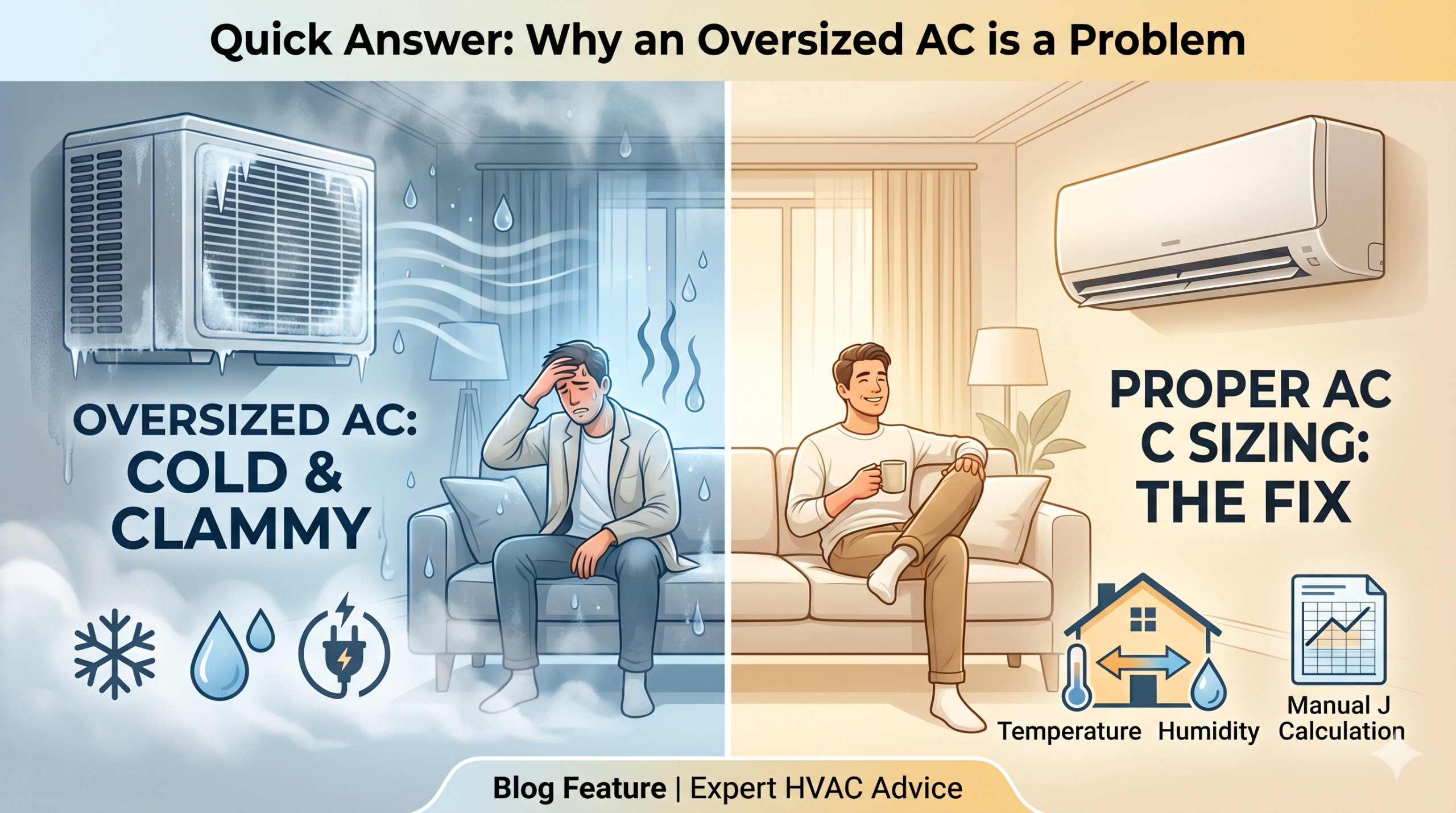
Quick Answer: An oversized air conditioner cools your home too quickly, then shuts off — a pattern called short cycling. The problem is that your AC has two jobs: lowering the temperature AND removing humidity. Short cycling handles the first job but fails the second, leaving your home feeling cold and clammy. On top of that, constant on-off cycling strains the compressor and blower motor, leading to earlier breakdowns and a shorter system lifespan. The fix is proper AC sizing before installation — not a bigger unit.
When the Okanagan summer hits 35°C, it’s natural for homeowners to want the most powerful cooling system available. Many believe that by “sizing up” their air conditioner, they are buying an insurance policy against the heat. However, HVAC systems do not work like car engines; you cannot simply add more horsepower for a better experience. In fact, installing a 4-ton unit where a 2.5-ton unit is required is one of the most expensive mistakes a homeowner can make.
The Science of the Cooling Cycle
To understand why oversizing is a problem, we have to look at what an air conditioner actually does. It is a common misconception that an AC “blows cold.” In reality, it is a heat-removal machine. It uses a refrigerant cycle to absorb thermal energy from your indoor air and move it outdoors.
What is Short Cycling?
When an AC unit is too large, it produces a massive “blast” of cold air. The thermostat, sensing a quick drop in temperature, signals the unit to shut down after only 5 or 6 minutes. This is short cycling, which can also affect furnaces.
Because the unit reached the target temperature so fast, it never had the chance to remove the humidity. The result? You are left with air that is technically 22°C but feels “heavy” and “clammy” because the relative humidity remains at 60% or 70%. In Kelowna, where summer humidity can fluctuate, this lack of moisture control is the difference between a comfortable home and a stagnant one.
The “Cold Jungle” Effect: Humidity and Air Quality
Oversized units create what HVAC professionals call the “Cold Jungle” effect. Beyond simple discomfort, high humidity levels caused by an oversized AC can lead to significant indoor air quality (IAQ) issues:
- Mould and Mildew: If your AC doesn’t stay on long enough to dry out the air, moisture can accumulate in your ductwork, in the corners of closets, or behind furniture. This creates a breeding ground for mould.
- Dust Mites: These common allergens thrive in environments with humidity above 50%. A properly sized unit keeps humidity low enough to keep dust mite populations in check.
- Filtration Gaps: Your air filter only cleans the air when the fan is running. If an oversized unit only runs for 15 minutes out of every hour, your air is only being filtered 25% of the time. A correctly sized unit runs more frequently, providing constant air filtration and better indoor air quality.
How Oversizing Shortens Equipment Life
The most expensive component of your air conditioner is the compressor. The hardest thing a compressor ever does is start up. During the first few seconds of a cycle, the motor experiences “inrush current,” drawing significantly more electricity and generating more internal heat than it does while running steadily.
An oversized unit might start 8 to 10 times per hour, whereas a correctly sized unit might start only 2 or 3 times. Over a decade, this translates to thousands of extra “hard starts.”
- Component Fatigue: Capacitors, contactors, and fan motors wear out twice as fast.
- Lubrication Issues: It takes a few minutes for oil to circulate properly through the system. Short cycles mean the compressor is often shutting down just as it achieves optimal lubrication.
- Warranty Denials: Many manufacturers are now looking at cycle counts in their “smart” equipment. If a unit was clearly oversized for the home, it can complicate warranty claims for premature compressor failure.
Proper AC Sizing: The Right Approach
At Vision Plumbing Heating Cooling, we don’t use “rules of thumb” like “one ton per 500 square feet.” Those outdated methods don’t account for the unique architecture of Okanagan homes. Instead, we assess each home individually. In the rare event we can’t directly ascertain heat loss or heat gain, we may perform a Manual J Load Calculation to dial in the right size precisely.
The factors we consider include:
- Orientation to the Sun: A home with large south-facing windows in Kelowna needs more cooling than the exact same home facing north.
- Insulation Levels: We check the R-value of your attic and wall insulation. A well-insulated home requires a much smaller AC unit.
- Air Leakage: Visual inspections to assess how much heat may be entering through gaps in the building envelope.
- Occupancy: The number of people living in the home and the types of appliances used also add to the “heat load.”
By using this approach, we ensure your unit is “Goldilocks” sized — not too big, not too small, but just right. This maximizes your AC maintenance efforts by ensuring the machine is actually built for the task at hand.
Variable Speed Technology: A Modern Solution
If your home has complex cooling needs (like a sunroom that is only hot in the afternoon), we often recommend Variable Speed (Inverter) Compressors.
Unlike standard units that are either 100% “On” or 100% “Off,” variable-speed units can modulate their output. They can run at 30% capacity on a mild day and ramp up to 100% during a heatwave. This technology virtually eliminates short cycling and provides the most consistent dehumidification available.
The Bottom Line: Precision Saves Money
Investing in a smaller, correctly sized unit often costs less upfront and always costs less to operate. You’ll see lower monthly BC Hydro bills, experience fewer mid-summer breakdowns, and enjoy a home that feels crisp and dry rather than cold and damp.
If you suspect your current unit is oversized—or if you are planning a replacement—don’t settle for a contractor who just looks at your old unit’s label, book an HVAC contractor who installs the correct AC unit for your needs.
Frequently Asked Questions
The most common signs of an oversized air conditioner are short run times (unit shuts off after 5–8 minutes), high indoor humidity (clammy air), uneven temperatures between rooms, and frequent repairs to the compressor or capacitor.
Manual J is a scientific method used to calculate the precise amount of cooling a home needs. It accounts for over 30 variables, including window size, insulation levels, and local Kelowna climate data. Most homes can be sized accurately via a thorough on-site assessment without one, but a manual J calculation can help in cases where heat loss or heat gain is harder to determine.
Yes, but it may not cool it better. A larger unit reaches the set temperature quickly but shuts off before it can remove humidity, leaving the air damp and uncomfortable. If too large, this can also wear out the system prematurely.
In typical summer conditions, a properly sized air conditioner should run for approximately 15 minutes per cycle and turn on 2–3 times per hour.
Variable-speed units (inverters) can modulate their power to help mitigate minor oversizing. However, they are not a substitute for proper sizing; a significantly oversized unit will still short-cycle even at its lowest setting.